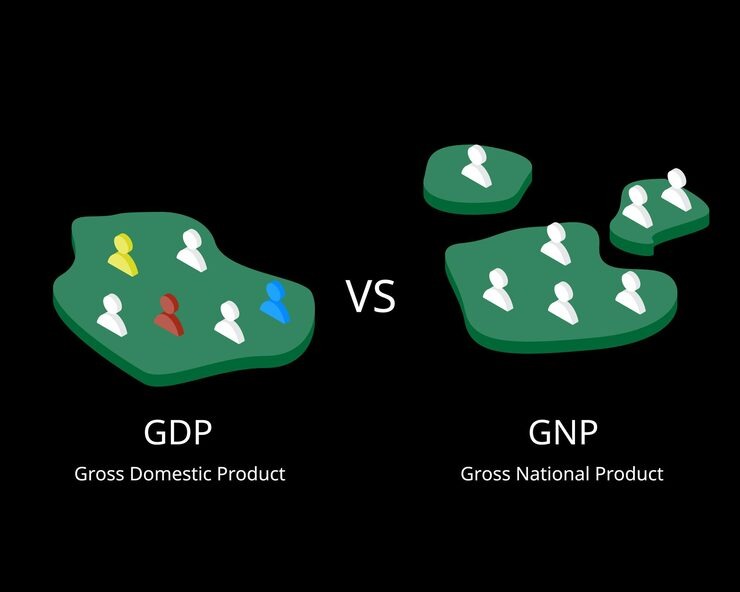
The difference fits in one sentence: GDP counts what is produced inside a country’s borders, no matter who produces it; GNP counts what a country’s citizens and companies produce, no matter where in the world they produce it. Borders vs passports.
The same factory, two answers
A German-owned car plant in South Carolina: its output belongs to US GDP (produced on US soil) and to German GNP (produced by German-owned capital). An American engineer working in Dubai adds to UAE GDP and US GNP. Formally:
GNP = GDP + income earned abroad by residents − income earned domestically by foreigners
Where the gap gets dramatic
For most large economies the two track closely. The famous exception is Ireland: decades of multinational headquarters booking production there swelled GDP far above what Irish residents actually earn — the gap runs tens of percent, and Irish statisticians publish a modified measure just to see their own economy clearly. Countries with large diasporas sending profits home (or hosting lots of foreign capital) all show meaningful gaps.
Which measure to use when
GDP won the popularity contest — it measures economic activity within a jurisdiction, which is what employment, tax capacity and policy respond to. GNP (and its modern cousin GNI, gross national income) answers a different question: how much income do this nation’s people actually command? For living standards and debt-burden comparisons, GNI per capita is often the more honest lens. The compounding of either measure over decades is just growth-rate math — the CAGR calculator works on economies exactly as it does on companies.
Is GNP or GDP bigger?
Depends on the country: nations earning heavily abroad (remittances, foreign investments) have GNP above GDP; hosts of foreign multinationals, the reverse.
What replaced GNP?
Most statistics agencies now publish GNI (gross national income) — conceptually GNP measured from the income side. The US switched emphasis to GDP in 1991.
Which is better for comparing living standards?
GNI per capita, generally — it reflects income accruing to residents rather than activity merely located in the country.