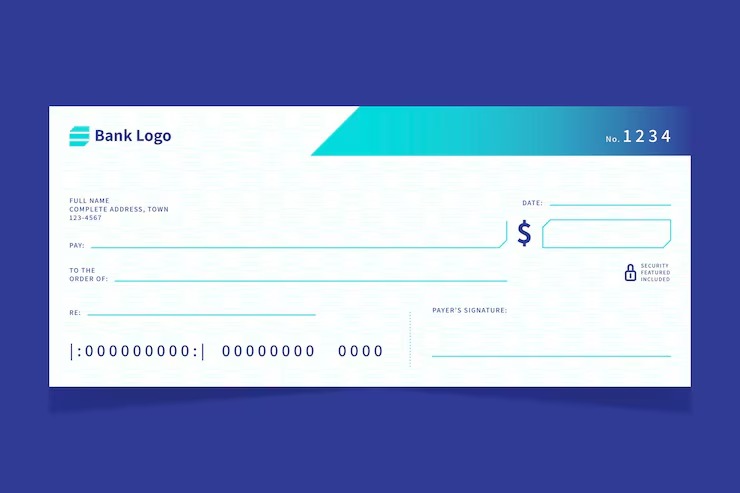
A check is a one-page payment instruction, and every field on it has a job. This guide covers the standard check format front to back: the nine parts, how to read the MICR line, the step-by-step way to fill a check so it resists tampering, the endorsement types on the back, and what actually happens after the check is handed over.
The parts of a check
| Part | Where | What it does |
|---|---|---|
| Payer details | Top left | Name and address of the account holder |
| Check number | Top right | Sequential ID for your register and reconciliation |
| Date line | Top right | When written; post-dating rarely prevents early cashing |
| Payee line | “Pay to the order of” | Who may deposit or cash it |
| Amount box | Right, with $ | Numeric amount |
| Amount in words | Long center line | Legally controls if the two amounts differ |
| Memo | Bottom left | Optional note — invoice number, purpose |
| Signature line | Bottom right | No signature, no check |
| MICR line | Very bottom | Routing, account and check numbers in machine-readable ink |
Reading the MICR line
The nine-digit routing number (printed between two ⑆ symbols) identifies the bank; the account number follows; the check number repeats at the end. These two numbers are what you copy for direct deposits and wire setups — and they are also why a photographed check is sensitive data: anyone holding the image holds everything needed to draft against the account. Treat voided checks and check images with the same care as passwords.
Writing a check, step by step
- Date — today’s date; post-dating is a request, not a lock.
- Payee — full legal name, no abbreviations a stranger could exploit.
- Numeric amount — tight against the dollar sign, so nothing can be inserted in front.
- Amount in words — start at the far left, cents as a fraction, then a line through all leftover space: “Forty-five and 00/100————”.
- Memo — invoice or account number, so the payee applies it correctly.
- Sign last — a signed blank check is cash with extra steps. Then record it in the register immediately, the habit that makes month-end account balance reconciliation painless.
Endorsements — the back of the check
A blank endorsement (signature only) makes the check payable to whoever holds it — sign only at the teller window. A restrictive endorsement (“For deposit only, acct #1234” above the signature) locks the check to one destination and is the correct default for businesses; deposit stamps do this automatically. A special endorsement (“Pay to the order of [name]”, signed) transfers the check to a third party — legal, but many banks refuse third-party checks in practice, so agree with the bank first.
Fraud: what alteration looks like, and the business defense
Check washing — chemically erasing payee or amount and rewriting — targets checks written in erasable ink with space left around the words. The habits above (gel pen, left-aligned words, drawn lines, tight numerals) close those gaps. Businesses writing volume add positive pay: the company sends its bank the list of checks issued (number, payee, amount) and the bank refuses anything that does not match. It is the single most effective anti-fraud control for business checking and typically costs a few dollars a month.
After the handover — the check lifecycle
Deposited checks are imaged and cleared electronically the same day or next; the paper itself never travels. Funds may show as available before the check truly clears, which is exactly the window fake-check scams exploit — “available” and “cleared” are different states. A check returned unpaid (insufficient funds, stop payment, closed account) reverses out of the depositor’s balance, usually with a fee. Stop payments can be placed on lost checks for a fee and last six months; a stale check — older than six months — may be refused by the bank, but refusal is discretionary, not automatic, which is one more reason to keep the register current rather than assume old checks died quietly.
Which amount wins if the numbers and words differ?
The amount in words legally controls under the UCC — though banks may simply return the check as ambiguous rather than choose.
Where is the routing number on a check?
The first nine digits on the MICR line at the bottom left, printed between two ⑆ symbols; the account number follows it.
Is the memo line legally binding?
Generally no — it is a reference note. Endorsement terms written on the back can carry more legal weight than the memo.
What is a restrictive endorsement?
Writing “For deposit only” with the account number above the signature — it locks the check to one destination and is the correct default for businesses.
What is positive pay?
A bank service where the business pre-registers every check it issues; the bank rejects any presented check that does not match the list — the strongest routine defense against altered checks.
How long is a check valid?
Banks may refuse checks older than six months, but refusal is discretionary — a stale check can still clear, so stop payment on anything you no longer want paid.