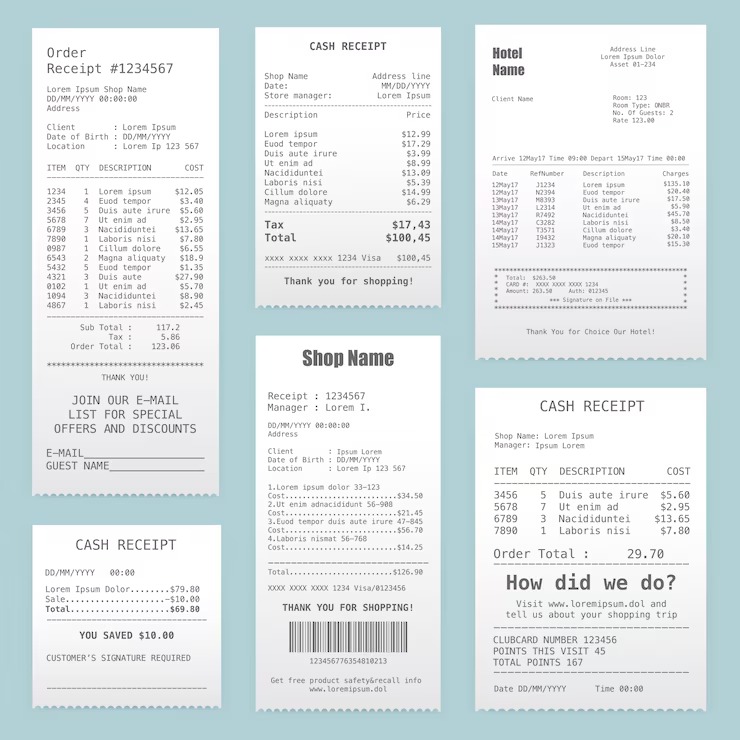
A cash receipt is the record created when a business receives money — from a cash sale, a customer paying an invoice, a loan drawdown, or the sale of an asset. “Cash” in accounting means every form of immediate payment: currency, checks, cards and bank transfers alike. This page covers what a valid receipt must contain, the journal entry for each source of cash, how a cash receipts journal batches the volume, and the one control that prevents most cash theft.
What a receipt must contain
| Field | Why it matters |
|---|---|
| Date received | Fixes the accounting period and the deposit-matching window |
| Amount and currency | The number everything reconciles back to |
| Payer | Which customer account to credit, or which source to record |
| What the payment was for | Invoice number, order, deposit — determines the credit side of the entry |
| Payment method | Cash, check number, card, transfer reference |
| Sequential receipt number | Gaps in the sequence are the first thing fraud examiners test |
The sequence matters more than it looks. Missing receipt numbers are the classic opening clue in a cash-skimming investigation, which is why auditors routinely test receipt continuity before anything else.
The journal entry — by source
Cash is an asset, so every receipt debits cash. The credit depends entirely on where the money came from:
| Source of cash | Debit | Credit |
|---|---|---|
| Cash sale | Cash | Sales revenue |
| Customer pays an invoice | Cash | Accounts receivable |
| Loan received | Cash | Loan payable |
| Sale of old equipment | Cash | Equipment (+ gain/loss line) |
| Customer advance / deposit | Cash | Unearned revenue (a liability) |
The second row trips up new bookkeepers: when a customer pays an invoice, revenue is not credited again — it was recorded at invoicing. The receipt merely converts a receivable into cash. Crediting revenue twice inflates sales and leaves receivables permanently overstated.
The cash receipts journal
High-volume businesses batch receipts in a dedicated cash receipts journal — one line per receipt, with columns for date, payer, receipt number, cash (debit), and the usual credit destinations (sales, receivables, other). A day might look like:
Date    Payer            Rcpt#   Cash Dr    Sales Cr   A/R Cr
Mar 8   Walk-in           2041     1,200      1,200        —
Mar 8   Hollis & Co       2042     8,500          —     8,500
Mar 8   Walk-in           2043       650        650        —
                                  10,350      1,850     8,500
Column totals — not individual lines — are posted to the general ledger at the end of the day or week, keeping the ledger readable while the journal preserves the detail. Every line still follows standard journal entry format logic: debits equal credits on each row and in the totals.
The control that matters most
Separation of duties: the person who receives cash should not be the person who records it, and neither should reconcile the bank account. Add three supporting habits — deposit intact daily (no paying expenses out of the till), match deposits to receipt batches, and have someone senior review the bank reconciliation monthly. In a three-person office full separation is impossible; the fallback is owner-level review of the reconciliation and deposit-to-receipt matching. Most small-business cash theft survives not because it is clever, but because one person controls the entire chain from till to books to bank statement.
Receipts and the audit trail
A receipt is one link in a chain: order → invoice → receipt → deposit → bank statement. An auditor should be able to walk any transaction in either direction across all five documents. Where the chain breaks — deposits that do not match receipt batches, receipts with no invoice behind them — is precisely where errors and fraud concentrate, so that is where testing starts.
Is a cash receipt the same as an invoice?
No — an invoice requests payment; a receipt proves payment happened. The invoice precedes the money, the receipt follows it.
Do card payments count as cash receipts?
Yes — in accounting, cash means any immediate-settlement payment: currency, checks, cards and transfers alike.
What is credited when a customer pays an invoice?
Accounts receivable — never revenue, which was already recorded at invoicing. The receipt converts a receivable into cash.
What is a cash receipts journal?
A special journal logging all incoming cash — one line per receipt with debit and credit columns — whose totals are posted to the general ledger.
What is the most important control over cash receipts?
Separation of duties: receiving, recording and reconciling handled by different people, with sequential receipt numbers and intact daily deposits.
How are customer deposits recorded?
Debit cash, credit unearned revenue — a liability until the work is delivered, at which point it converts to revenue.